


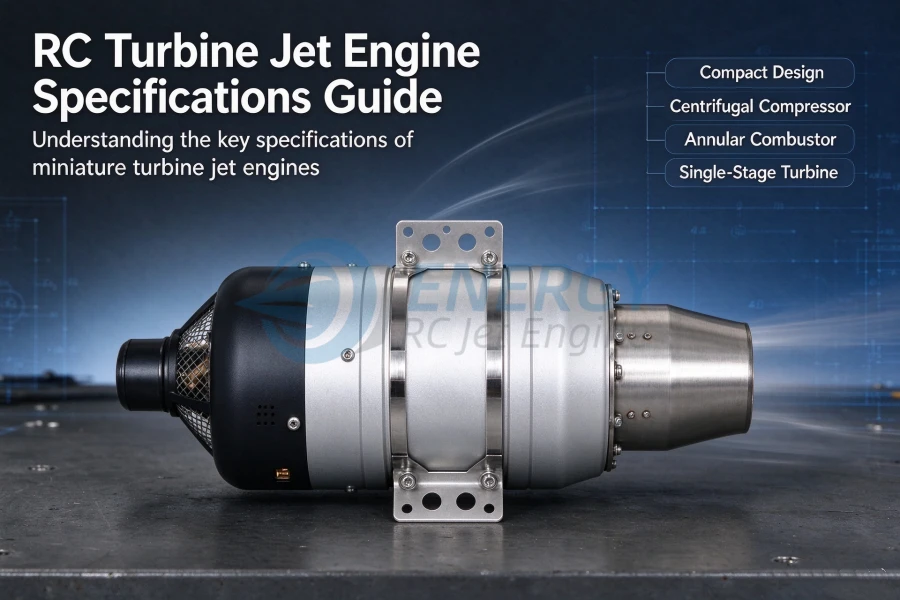
Choosing the right RC turbine jet engine involves more than comparing thrust ratings. Technical specifications such as rotational speed (RPM), exhaust gas temperature (EGT), fuel consumption, engine weight, dimensions, and electronic control systems all influence engine performance, installation requirements, and overall propulsion suitability.
For RC aircraft enthusiasts, UAV developers, experimental aviation projects, and aerospace research organizations, understanding these specifications is essential when evaluating a miniature turbojet engine or selecting a higher-thrust turbine propulsion system.
Energy RCJetEngine supplies turbine jet engines covering a thrust range from 1 kgf to 260 kgf, supporting different propulsion requirements across RC jets, unmanned aerial vehicles (UAVs), experimental aircraft, and specialized civil applications.
This guide explains the most important RC turbine jet engine specifications, how to interpret them, and what to consider when comparing different engine models.
What Are RC Turbine Jet Engine Specifications?
RC turbine jet engine specifications describe an engine’s thrust output, operating speed, temperature limits, fuel requirements, physical dimensions, weight, and control configuration.
These parameters help users evaluate whether an engine is suitable for a particular aircraft or propulsion project.
The most common specifications include:
Thrust: The force generated by the engine.
Maximum RPM: The maximum specified rotational speed.
EGT: Exhaust gas temperature, used as an operating and monitoring parameter.
Fuel Consumption: The amount of fuel consumed over a given period.
SFC or TSFC: Fuel consumption relative to the engine’s thrust output.
Weight: The mass of the engine or complete engine system.
Dimensions: Engine diameter and overall length.
ECU: Electronic control unit responsible for engine management.
Starter System: The mechanism used to initiate engine operation.
Not every manufacturer presents specifications in exactly the same format. Therefore, comparing engines requires checking measurement units, operating conditions, and whether the published figures refer to the bare engine or the complete system.
1. Thrust Rating: Understanding kgf, Newton and lbf
Thrust is one of the most important specifications of a turbojet engine. It represents the force generated by the engine to propel an aircraft forward.
RC turbine jet engine thrust is commonly expressed in kilograms-force (kgf), Newtons (N), or pounds-force (lbf).
These units can be converted as follows:
| THRUST UNIT | APPROXIMATE CONVERSION |
|---|---|
| 1 kgf | 9.81 N |
| 1 kgf | 2.205 lbf |
| 10 kgf | 98.1 N |
| 20 kgf | 196.1 N |
| 40 kgf | 392.3 N |
| 100 kgf | 980.7 N |
For example, a 20 kgf turbine engine produces approximately 196 N of thrust.
When comparing engines, make sure the figures represent the same type of rating. Some manufacturers specify nominal thrust, while others publish maximum or peak thrust. These values should not be treated as interchangeable.
Understanding Different Thrust Classes
RC turbine engines are available in different thrust classes to accommodate different aircraft sizes and propulsion requirements.
Energy RCJetEngine provides turbine engine solutions across the following overall thrust range:
| THRUST RANGE | GENERAL CLASSIFICATION |
|---|---|
| 1–5 kgf | Micro and lightweight turbojet engines |
| 6–20 kgf | Small RC turbine engines |
| 21–50 kgf | Medium-thrust turbine engines |
| 51–100 kgf | High-performance turbine propulsion |
| 101–150 kgf | High-thrust turbine engines |
| 151–260 kgf | Specialized high-thrust propulsion systems |
These categories are general selection references rather than universal industry classifications. Actual engine suitability depends on aircraft design, installation conditions, operating requirements, and the manufacturer’s specifications.
2. Maximum RPM: Understanding Turbine Engine Speed
RPM stands for revolutions per minute. It describes how many times a rotating engine component completes a revolution in one minute.
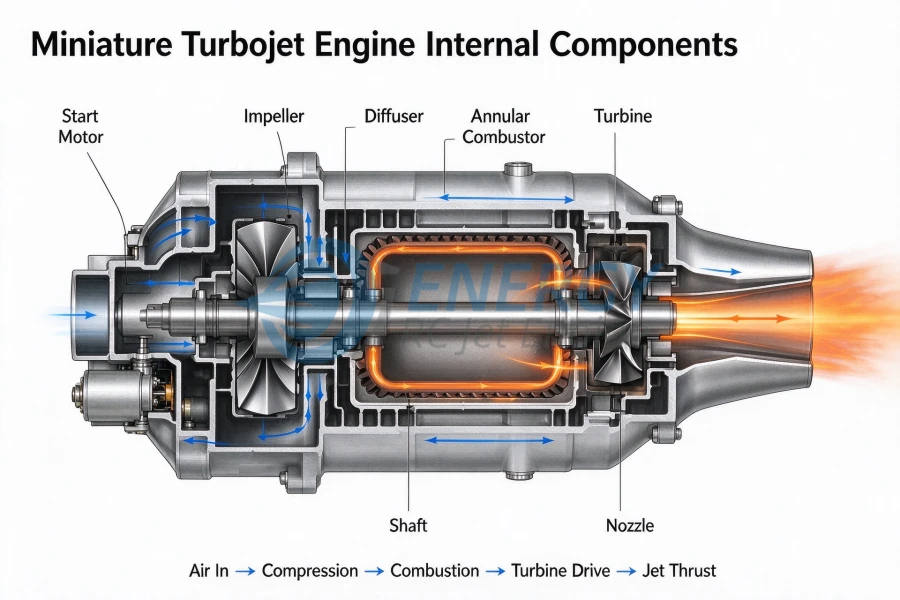
In a miniature turbojet engine, the compressor and turbine rotate at very high speeds. The rotational speed is an important operating parameter because it relates to the engine’s airflow, pressure generation, and operating condition.
However, a higher RPM does not automatically mean a higher thrust rating.
Different engine designs use different compressor geometries, airflow capacities, turbine configurations, and operating speeds. A smaller micro turbojet may operate at a higher RPM than a larger high-thrust engine while producing considerably less thrust.
When evaluating RPM specifications, consider:
Maximum rated rotational speed.
Idle rotational speed, if provided.
Continuous operating limits.
Whether the RPM figure refers to a measured value or a maximum permitted value.
The relationship between RPM, thrust, and exhaust temperature.
For a meaningful comparison, always evaluate RPM together with thrust and other performance specifications.
3. Exhaust Gas Temperature (EGT): What Does It Mean?
Exhaust Gas Temperature (EGT) is a temperature measurement used to monitor the thermal condition of a turbine engine.
In RC turbine engines, temperature information is commonly monitored by the electronic control unit (ECU) to help manage engine operation and identify abnormal operating conditions.
EGT is important because excessive temperatures can affect turbine components, combustion system performance, and engine service life.
When reviewing EGT specifications, check:
The maximum specified temperature.
Whether the figure represents a normal operating value or a temperature limit.
The location of the temperature sensor.
Whether the temperature is measured during idle, acceleration, or maximum thrust operation.
The manufacturer’s operating and maintenance instructions.
Different manufacturers may measure or report temperature at different locations. For this reason, EGT values should not be compared directly without understanding the measurement method.
A lower published EGT does not automatically indicate a better engine. Temperature must be considered alongside engine design, materials, thrust output, and operating conditions.
Read More:How to Buy Turbojet Engines in Bulk: Wholesale, OEM/ODM & Custom Solutions
4. Fuel Consumption and Specific Fuel Consumption
Fuel consumption indicates how much fuel an engine uses during operation.
For RC turbine jet engines, fuel consumption is commonly expressed in:
ml/min (milliliters per minute)
g/min (grams per minute)
kg/h (kilograms per hour)
The reported value may vary depending on engine thrust, operating speed, fuel type, and test conditions.
Fuel Consumption at Different Operating Conditions
A turbine engine does not consume the same amount of fuel at every operating point.
Fuel consumption generally changes with throttle setting and engine load. Therefore, a manufacturer’s specification may provide separate figures for idle and maximum thrust operation.
When comparing two engines, check whether their fuel consumption values refer to:
Idle operation.
Maximum rated thrust.
A specified intermediate operating condition.
A complete test cycle or a steady-state measurement.
What Is SFC or TSFC?
Specific Fuel Consumption (SFC) describes fuel use relative to a specified engine output.
For turbojet engines, the more precise term is Thrust Specific Fuel Consumption (TSFC). It expresses the fuel mass flow required to produce a unit of thrust over a given period.
A lower TSFC generally indicates less fuel consumption for the same thrust under comparable test conditions.
However, SFC figures may be reported using different units and measurement methods. Before comparing published figures, confirm the units and operating conditions.
For a deeper explanation of turbine engine fuel consumption, readers can also explore our related guide on turbojet engine fuel consumption.
5. Engine Weight and Dimensions
Engine weight and physical dimensions are important when selecting a turbine engine for an RC aircraft, UAV, or experimental aircraft.
The engine must fit within the available installation space while remaining compatible with the aircraft’s structural design and weight limits.
Common dimensional specifications include:
| SPECIFICATION | MEANING |
|---|---|
| Engine Weight | Mass of the engine itself |
| Complete System Weight | Mass including specified accessories and components |
| Diameter | Maximum external engine diameter |
| Length | Overall engine length |
| Nozzle Length | Exhaust nozzle length, where separately specified |
One important consideration is whether the published weight includes the ECU, fuel pump, starter, cables, valves, and other accessories.
For example, two engines may have similar thrust ratings but different complete system weights because of differences in their configurations.
Before purchasing, confirm the complete installation dimensions and system weight rather than relying only on the bare engine specification.
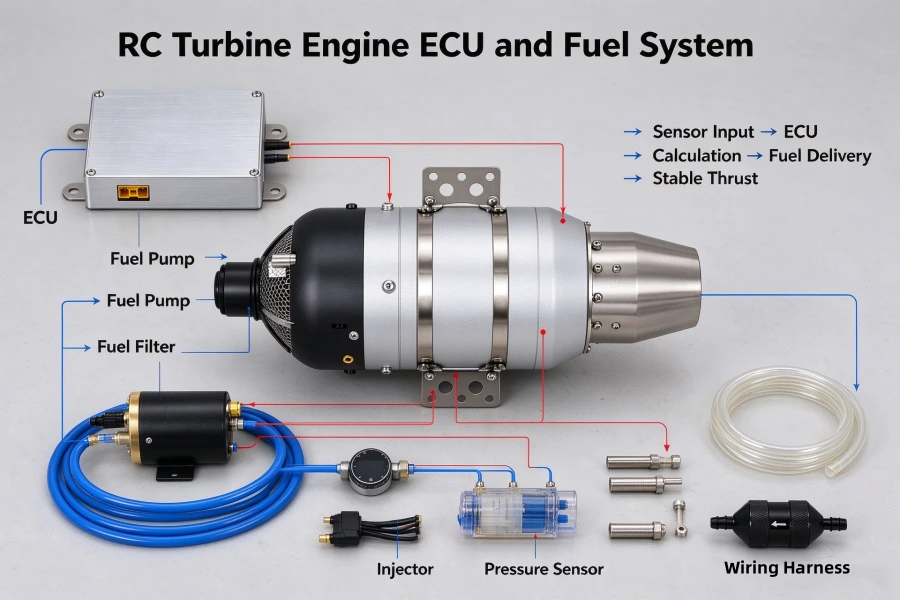
6. ECU, Starter and Fuel System
Modern RC turbine jet engines commonly use electronic systems to manage starting, acceleration, throttle response, and operating monitoring.
The exact configuration depends on the engine model.
Electronic Control Unit (ECU)
The ECU is the electronic control system responsible for managing important engine functions.
Depending on the design, ECU functions may include:
Engine starting sequence management.
Throttle control.
RPM monitoring.
Temperature monitoring.
Fuel system control.
Operating status monitoring.
Protective shutdown functions.
An advanced ECU helps coordinate engine operation and provides important information during testing and use.
Starter System
A starter system initiates engine rotation during the starting sequence.
Some turbine engines use electric or brushless starter systems to provide the required initial rotational speed.
When comparing engines, check whether the starter is integrated or supplied as a separate component.
Fuel Pump and Fuel Delivery System
The fuel system delivers fuel to the combustion chamber at the required flow rate and pressure.
Depending on the engine configuration, the system may include an integrated or external fuel pump, fuel valves, filters, and associated control components.
An integrated configuration can simplify installation, while a separate configuration may provide different installation options.
Always follow the manufacturer’s requirements for fuel compatibility, fuel filtration, system installation, and maintenance.
7. How to Compare Different RC Turbine Jet Engines
Comparing turbine engines requires more than looking at one specification.
A suitable engine should meet the aircraft’s propulsion requirements while remaining compatible with its installation space, weight limits, fuel system, and control configuration.
The following comparison framework can help:
| EVALUATION FACTOR | WHAT TO CHECK |
|---|---|
| Thrust | Nominal, maximum, or peak thrust |
| RPM | Maximum and idle rotational speed |
| EGT | Temperature measurement and operating limits |
| Fuel Consumption | Fuel flow at specified operating points |
| SFC / TSFC | Fuel efficiency under comparable conditions |
| Weight | Bare engine or complete system |
| Dimensions | Diameter, length, and nozzle configuration |
| ECU | Control, monitoring, and protection functions |
| Starter | Integrated or separate starting system |
| Fuel Compatibility | Approved fuel types |
| Maintenance | Inspection intervals and service requirements |
Why Test Conditions Matter
Published engine specifications are meaningful only when their test conditions are understood.
Thrust and fuel consumption can be affected by atmospheric pressure, ambient temperature, fuel characteristics, installation configuration, and measurement methods.
For reliable comparisons, use manufacturer datasheets and test reports that identify the relevant measurement conditions.
Avoid comparing one engine’s maximum thrust with another engine’s nominal thrust, or comparing fuel consumption values measured at different operating points.
Learn More:Turbojet Engine Fuel Consumption: How to Estimate Fuel Requirements and Operating Costs
8. Understanding the 1–260 kgf RC Turbine Jet Engine Range
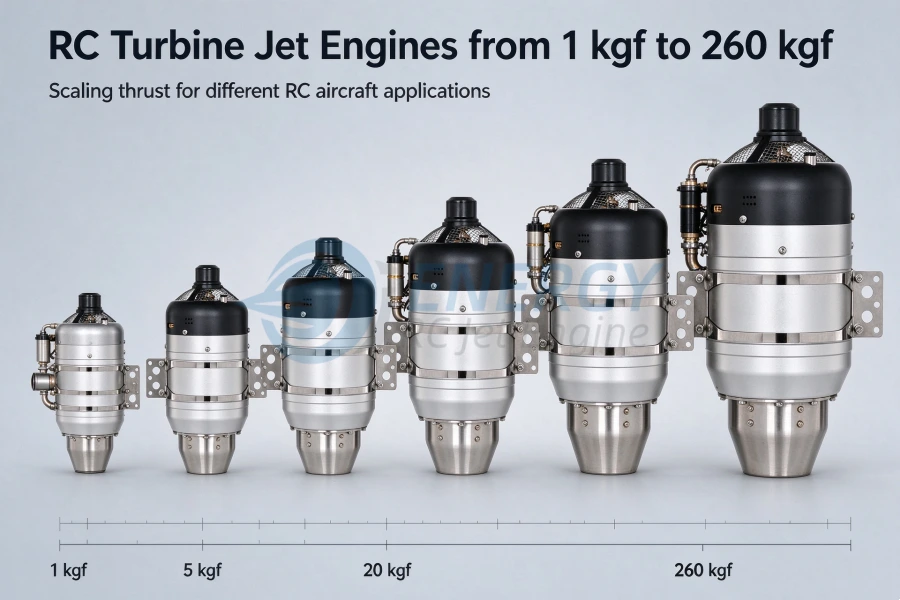
Energy RCJetEngine offers turbine jet engine solutions covering thrust ratings from 1 kgf to 260 kgf.
The range supports different propulsion requirements, from compact micro turbojet engines to larger high-thrust turbine systems.
Depending on the model, available configurations and technical specifications may include:
Different thrust ratings and rotational speeds.
Electronic control systems.
Automatic or electric starting configurations.
Integrated or separate fuel delivery systems.
Different engine dimensions and weight configurations.
Model-specific fuel compatibility and monitoring functions.
The product range includes several engine families and configurations for different RC aircraft, UAV propulsion, experimental aviation, and specialized civil applications.
For detailed model specifications, customers should refer to the corresponding product datasheets and product pages.
When selecting an engine, it is important to evaluate the complete technical configuration rather than choosing solely by thrust rating.
9. Applications of RC Turbine Jet Engines
RC turbine jet engines are used in a variety of specialized propulsion applications.
RC Model Jets
Turbine propulsion provides a jet-engine configuration for advanced radio-controlled aircraft, including scale jet models and high-performance model aircraft.
Unmanned Aerial Vehicles (UAVs)
Depending on aircraft design and propulsion requirements, turbine engines may be considered for selected fixed-wing UAV platforms and specialized unmanned aviation projects.
Engine selection should account for thrust requirements, endurance targets, fuel capacity, aircraft structure, and integration requirements.
Experimental Aviation and Aerospace Research
Miniature turbine engines can support experimental propulsion studies, engineering research, and controlled testing environments.
Technical Training and Demonstration
Turbine engine systems can also be used in technical education, engineering demonstrations, and specialized propulsion training.
The appropriate engine configuration depends on the project’s technical requirements and applicable operating regulations.
10. How to Select the Right RC Turbine Jet Engine
Before selecting a turbine engine, buyers should define the main requirements of their aircraft or propulsion project.
Consider the following factors:
1. Required Thrust
Determine the thrust requirement based on aircraft design, total mass, aerodynamic characteristics, and intended operating conditions.
2. Engine Weight
Check the complete engine system weight and its effect on aircraft weight distribution.
3. Installation Dimensions
Confirm the available installation space, engine diameter, overall length, mounting arrangement, and exhaust clearance.
4. Fuel Consumption
Evaluate fuel flow at relevant operating points and calculate the required fuel capacity for the intended operating duration.
5. Control and Starting Configuration
Check ECU compatibility, starter configuration, fuel pump arrangement, and monitoring functions.
6. Maintenance and Technical Support
Review maintenance requirements, service intervals, spare parts availability, and manufacturer support.
7. Customization Requirements
For specialized aircraft and propulsion projects, a standard engine configuration may not meet every requirement. Discuss possible customization with the manufacturer before placing an order.
Frequently Asked Questions About RC Turbine Jet Engine Specifications
What is the thrust rating of an RC turbine jet engine?
Thrust rating describes the force generated by the engine. It is commonly expressed in kgf, Newtons (N), or pounds-force (lbf). The appropriate thrust rating depends on the aircraft and its propulsion requirements.
How do you convert kgf to Newtons?
One kilogram-force (kgf) is approximately equal to 9.81 Newtons (N). For example, a 20 kgf engine produces approximately 196 N of thrust.
Does higher RPM mean higher thrust?
No. RPM alone does not determine thrust. Engine thrust also depends on airflow, compressor design, combustion performance, turbine configuration, and nozzle characteristics.
What does EGT mean in a turbojet engine?
EGT stands for Exhaust Gas Temperature. It is a temperature measurement used to monitor the engine’s thermal operating condition. The applicable limits and measurement locations depend on the engine design.
What is the difference between fuel consumption and TSFC?
Fuel consumption measures the amount of fuel used over time. Thrust Specific Fuel Consumption (TSFC) relates fuel mass flow to the thrust produced, allowing fuel efficiency to be compared under similar operating conditions.
What thrust range does Energy RCJetEngine offer?
Energy RCJetEngine provides turbine jet engine solutions covering a thrust range from 1 kgf to 260 kgf. Specific models, configurations, and technical specifications vary across the product range.
Can RC turbine jet engines be customized?
Customization may be available depending on the engine model and project requirements. Customers can discuss technical configurations, OEM/ODM manufacturing, and custom propulsion solutions with Energy RCJetEngine.
What information should I provide when requesting a turbine engine quotation?
To help identify a suitable configuration, provide the required thrust, intended application, target quantity, preferred technical specifications, destination country, and any customization requirements.
Conclusion: Understanding Specifications Before Choosing a Turbine Engine
Understanding RC turbine jet engine specifications is essential when selecting a propulsion system for RC aircraft, UAV projects, experimental aviation, and specialized research applications.
Thrust, RPM, EGT, fuel consumption, SFC, weight, dimensions, ECU configuration, and starter systems should be evaluated together. No single specification can fully describe an engine’s suitability.
With turbine jet engine solutions ranging from 1 kgf to 260 kgf, Energy RCJetEngine supports different propulsion requirements through standard engine supply, customized configurations, OEM/ODM cooperation, and technical assistance.
Whether you are sourcing a micro turbojet engine, evaluating a medium-thrust RC turbine, or planning a specialized high-thrust propulsion project, our team can help you review the available configurations.
Contact Energy RCJetEngine
Website: https://energyrcjetengine.com/
Email: service@energysplendor.com
WhatsApp: +86 15828284573
Contact our team to discuss your application, request technical information, and explore turbine jet engine solutions by Energy RCJetEngine.