
















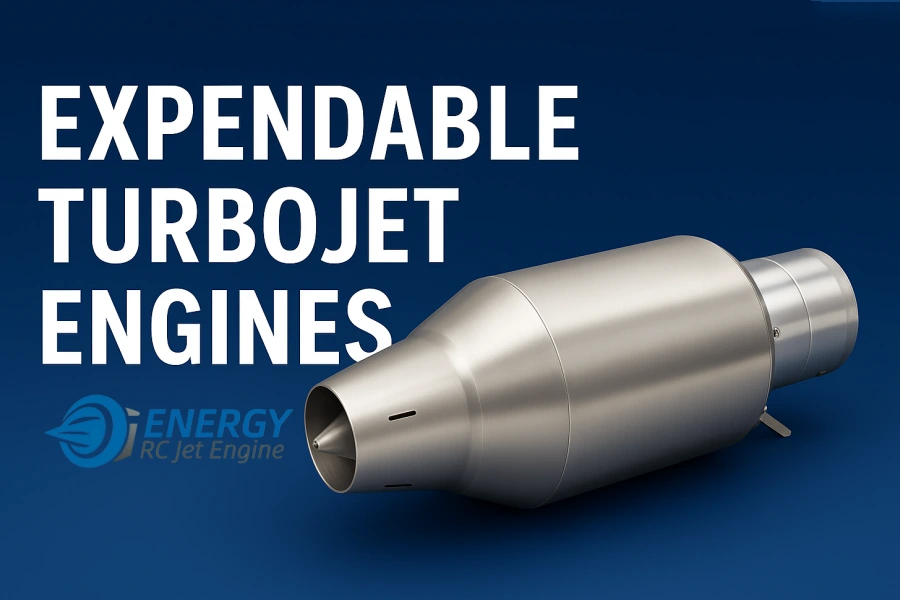
Expendable turbojet engines play a critical role in high-speed unmanned platforms, aerial test vehicles, and short-duration flight validation programs where mission performance, thrust density, and system simplicity are more important than long-term reuse or overhaul capability.
Unlike reusable UAV propulsion systems designed for hundreds of flight hours, expendable turbojet engines are purpose-built for defined operational missions. They are optimized to deliver reliable thrust over a limited service window, making them well suited for aerial testing, performance evaluation, and mission-specific unmanned aircraft.
This article explains the technical design philosophy, expected service life, and typical use cases of expendable turbojet engines, with practical reference to a 60 kgf thrust-class configuration commonly used in high-speed test platforms.
What Defines an Expendable Turbojet Engine?
An expendable turbojet engine is engineered around mission duration rather than total life hours.
Instead of maximizing Time Between Overhaul (TBO), the design focus is placed on:
Elevada relação impulso/peso
Compact engine architecture
Stable performance at sustained high power
Simplified system integration
Engineering Definition:
An expendable turbojet engine is designed to operate reliably for a predefined mission profile without overhaul or extended life-cycle requirements.
This design approach is widely adopted in aerial test vehicles, experimental UAV platforms, and evaluation systems.
Expected Service Life and Operating Profile
(60 kgf Thrust-Class Reference)
Service life is defined by total accumulated operating time under rated conditions, not by maintenance intervals.
Typical Design Parameters
Total design life: 20–50 operating hours
Single mission duration: 30–120 minutes
Power setting: Continuous high power or near maximum thrust
Maintenance concept: No overhaul; replacement after mission completion
High-Load Test Configurations
For platforms requiring maximum performance:
Design life: 5–20 hours
Elevated turbine inlet temperature (EGT) limits
Sustained operation at 95–100% rated RPM
These parameters are carefully validated to ensure predictable and repeatable performance within the defined mission envelope.
Engineering Trade-Offs Behind Expendable Design
Shorter service life is a conscious engineering decision, enabling higher performance within a compact system.
Reduced Thermal Margin
Expendable turbojet engines typically operate closer to material temperature limits, allowing:
Increased thrust output
Reduced engine mass
Smaller airframe integration footprint
Optimized Materials and Structural Design
High-temperature alloys selected for mission duration
Reduced use of life-extending coatings
Structural margins sized for expected mission loads
Mission-Specific Bearing and Lubrication Strategy
Lubrication systems designed for short-duration reliability
Acceptable wear rates matched to mission time
Simplified oil system architecture
Performance-Oriented ECU Control Logic
Rapid engine start and acceleration
Higher allowable RPM and temperature thresholds
Control strategy optimized for stable high-power operation
Expendable vs Reusable Turbojet Engines
(Technical Comparison – 60 kgf Class)
| Parâmetro | Expendable Turbojet | Reusable UAV Turbojet |
|---|---|---|
| Design life | 5–50 hours | 300–500 hours |
| TBO | Not required | 150–300 hours |
| Primary objective | Mission performance | Lifecycle efficiency |
| ECU limits | Performance-oriented | Conservative |
| Integration focus | Compact & lightweight | Endurance-oriented |
Typical High-Speed and Test-Oriented Applications
Aerial Test and Evaluation Platforms
Used in:
Flight envelope validation
Ensaio do sistema de propulsão
High-speed aerodynamic research
Mission-Specific UAV Platforms
Ideal para:
Short-duration, high-speed missions
Cost-sensitive test programs
Platforms without recovery requirements
Experimental and Validation Aircraft
Applied in:
Sensor and payload evaluation
Control system validation
System integration trials
Integration and Procurement Considerations
When selecting an expendable turbojet engine, engineering teams typically evaluate:
Required thrust level and acceleration profile
Mission duration and power settings
Integration envelope and mounting constraints
Fuel compatibility and control interfaces
A well-matched expendable engine can significantly reduce system complexity and overall program cost for test-oriented platforms.
Conclusion: Mission-Oriented Propulsion for High-Speed UAV Systems
Expendable turbojet engines are not simplified alternatives, but specialized propulsion systems designed for clearly defined operational objectives.
For UAV platforms and aerial test applications where performance, predictability, and cost control are critical, expendable turbojet engines offer a technically sound and operationally efficient solution.
Engineering Support and Customization
Expendable turbojet engines can be configured for:
Different thrust classes
Specific mission durations
Customized ECU parameters
Integration with experimental airframes
If you are evaluating propulsion solutions for high-speed UAV platforms or aerial test programs, technical consultation and configuration support are available upon request.