


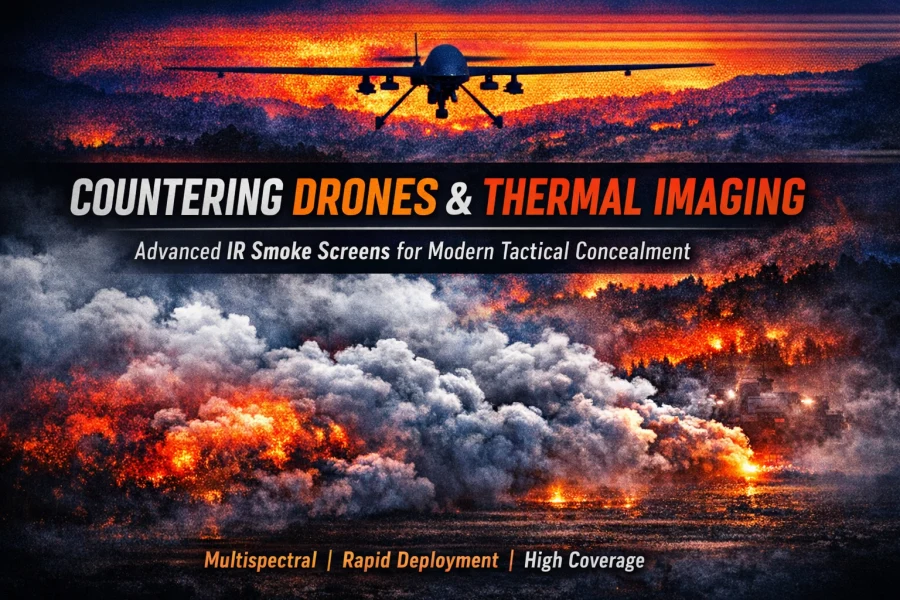
Introduction: The End of Traditional Concealment
In modern tactical environments, the concept of concealment has fundamentally changed. For decades, darkness, terrain, and conventional smoke screens were sufficient to obscure movement and protect personnel from visual detection. However, the rapid advancement of drone surveillance and thermal imaging technologies has rendered these traditional methods increasingly ineffective.
Today, unmanned aerial systems (UAS), equipped with infrared (IR) and thermal sensors, can detect heat signatures, track movement through low-visibility conditions, and provide real-time targeting data. As a result, being “out of sight” no longer guarantees being undetected.
This shift has created an urgent demand for more advanced concealment strategies—ones that go beyond visible smoke and actively disrupt modern sensing technologies. Among the most effective solutions is the use of multispectral smoke screens, specifically designed to counter drones and thermal imaging systems.
The Rise of Drone and Thermal Surveillance
Drones have become a central component of modern military, security, and law enforcement operations. Their ability to hover, scan large areas, and transmit live data makes them a powerful surveillance tool.
At the same time, thermal imaging has become more accessible and more capable. Unlike traditional cameras, thermal sensors detect differences in heat rather than visible light. This allows operators to:
- Identify personnel in complete darkness
- Detect vehicles through foliage or light cover
- Track movement even in visually obscured environments
When combined, drones and thermal imaging create a persistent surveillance network that is extremely difficult to evade.
This is particularly problematic in tactical scenarios where mobility, concealment, and timing are critical. Whether it’s troop movement, vehicle repositioning, or infrastructure protection, the inability to remain hidden can quickly compromise an entire operation.
Why Traditional Smoke Screens Are No Longer Enough
Conventional smoke screens are primarily designed to block visible light. They create a dense cloud that limits human vision and optical systems such as cameras or binoculars. While this was effective in the past, it offers limited protection against modern sensors.
Thermal imaging systems operate in infrared wavelengths—typically in the 3–5 μm (mid-wave) and 8–14 μm (long-wave) bands. These wavelengths can penetrate standard smoke, allowing heat signatures to remain visible even when visual sightlines are blocked.
As a result:
- Personnel can still be detected by their body heat
- Vehicles remain visible due to engine and exhaust temperatures
- Drone-mounted sensors can maintain tracking through conventional smoke
This has led to a critical gap in traditional concealment methods—one that requires a more sophisticated, technology-driven solution.
The Science Behind IR Smoke and Thermal Obscuration
To effectively counter thermal imaging, smoke systems must operate across multiple spectra—not just the visible range. This is where infrared (IR) smoke и multispectral obscurants come into play.
Unlike conventional smoke, IR smoke is engineered using specialized particles that interact with infrared radiation. These particles work through two primary mechanisms:
1. Absorption of Infrared Radiation
Certain المواد within the smoke absorb infrared energy, reducing the amount of heat radiation that reaches the sensor. This effectively lowers the apparent temperature of the target.
2. Scattering of Infrared Waves
Microscopic particles disperse infrared waves in multiple directions, distorting the thermal image and reducing clarity.
Together, these effects significantly degrade the performance of thermal imaging systems. Rather than completely “hiding” an object, the goal is often to:
Reduce thermal contrast to the point where detection, identification, or targeting becomes unreliable.
This concept—thermal disruption rather than total concealment—is key to modern countermeasure strategies.
How Smoke Screens Disrupt Drone Surveillance
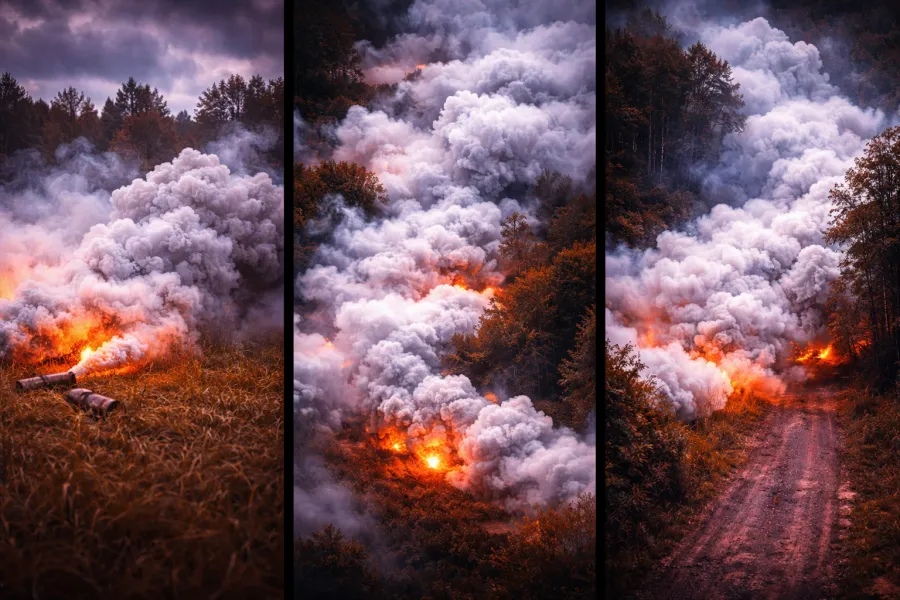
Smoke screens play a critical role in countering drone-based surveillance by interfering with both visual and sensor-based detection.
1. Visual Obstruction
Dense smoke clouds limit the drone’s ability to capture clear images, especially for standard RGB cameras used in many commercial and tactical drones.
2. Thermal Signature Degradation
IR smoke reduces the contrast between a target and its background, making it harder for thermal cameras to distinguish shapes and movement.
3. Target Tracking Interruption
Drones rely on consistent visual or thermal data to track moving targets. Smoke introduces noise and distortion, which can:
- Break target lock
- Delay recognition
- Force repositioning or retreat
4. Sensor Saturation and Confusion
In high-density deployments, smoke can overwhelm sensors, especially when combined with environmental factors such as wind or terrain.
This makes smoke an effective, flexible, and relatively low-cost method for disrupting drone operations—particularly in short-duration, high-mobility scenarios.
Key Capabilities of Modern Tactical Smoke Systems
Modern tactical smoke systems are designed to address the limitations of traditional smoke while meeting the demands of dynamic operational environments.
Key capabilities include:
Rapid Deployment
Time is critical in tactical situations. Advanced systems can generate effective smoke screens within seconds, providing immediate concealment.
Multispectral Coverage
Effective systems operate across visible, infrared, and sometimes laser wavelengths, ensuring comprehensive protection.
High-Density Output
Dense smoke is essential for both visual and thermal disruption, particularly in open environments.
Wide-Area Coverage
The ability to cover large مناطق quickly is crucial for protecting personnel, vehicles, or infrastructure.
Mobility and Flexibility
Systems may be vehicle-mounted, portable, or modular, allowing deployment across different operational scenarios.
Applications Across Modern Operations
The use of advanced smoke systems extends far beyond traditional battlefield scenarios.
Military Operations
- Troop movement concealment
- Vehicle and convoy protection
- Counter-surveillance during repositioning
Counter-Drone Defense
- Temporary denial of aerial visibility
- Protection of forward operating bases
- Disruption of reconnaissance missions
Law Enforcement and Security
- Tactical entry operations
- Crowd control scenarios
- High-risk intervention concealment
Critical Infrastructure Protection
- Shielding sensitive sites from drone observation
- Emergency response scenarios
- Temporary visual and thermal masking
High-Speed Smoke Deployment: A New Generation of Systems
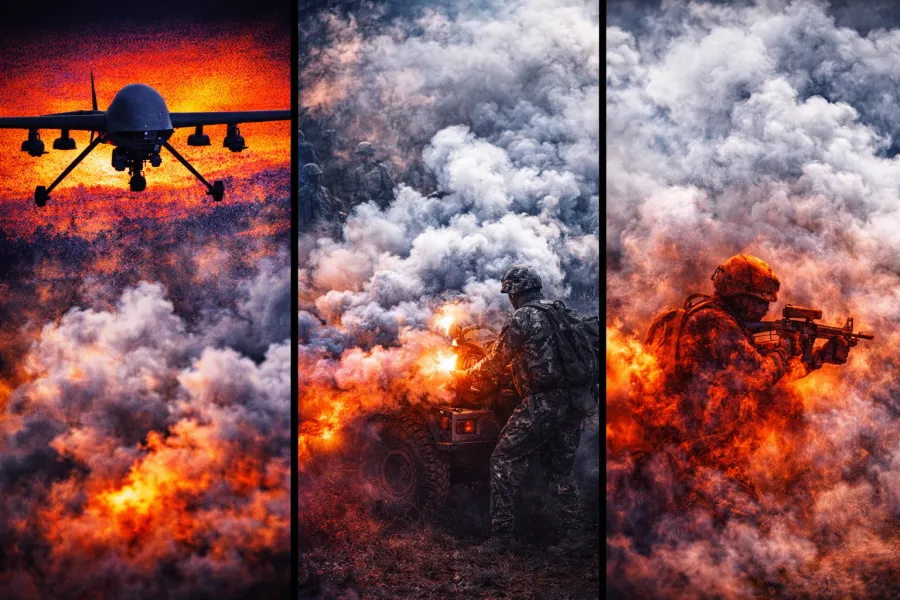
One of the most significant advancements in this field is the development of high-speed, jet-powered smoke generation systems.
Unlike traditional smoke generators, which rely on slower combustion or vaporization methods, these systems use turbine or jet-based mechanisms to rapidly disperse smoke over large areas.
Ключевые преимущества включают:
- Ultra-fast smoke projection for immediate coverage
- Long-range dispersion, enabling stand-off deployment
- High output density, improving both visual and IR effectiveness
- Continuous operation capability for sustained concealment
These systems are particularly well-suited for scenarios where speed, scale, and reliability are critical—such as counter-drone operations or rapid tactical deployments.
Future Trends: Multispectral Warfare and Adaptive Concealment
As sensing technologies continue to evolve, so too must concealment strategies.
Future developments are likely to include:
- Integration with AI-driven threat detection systems
- Adaptive smoke systems that respond to sensor types in real time
- Enhanced المواد for broader spectral coverage
- Combined use with electronic warfare and jamming systems
In this evolving landscape, concealment is no longer about simply hiding—it is about actively disrupting detection systems across multiple domains.
Conclusion: From Cover to Countermeasure
The role of smoke in tactical operations has transformed from a basic visual barrier to a sophisticated countermeasure against advanced surveillance technologies.
In an era dominated by drones and thermal imaging, effective concealment requires more than traditional solutions. Multispectral smoke systems provide a practical, scalable, and highly effective way to reduce detection risk and maintain operational advantage.
As modern threats continue to evolve, so too must the tools used to counter them. Tactical smoke generators—especially those capable of high-speed, multispectral deployment—are quickly becoming an essential component of contemporary defense and security strategies.