
















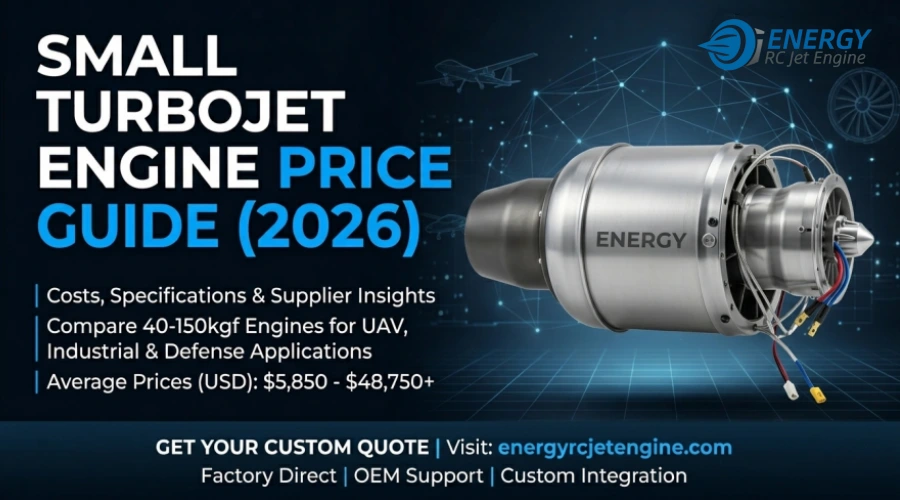
Small Turbojet Engine Price Guide (2026)
If you are sourcing a small turbojet engine for a UAV, target drone, or aerospace research project, your primary question is likely straightforward: How much does a small turbojet engine actually cost?
In this 2026 procurement guide, we break down real-world market pricing, analyze the critical technical factors that drive costs, and help you select the ideal propulsion system for your specific mission requirements.
💰 Average Small Turbojet Engine Prices (2026)
The market price of a small turbojet engine is primarily dictated by its thrust class, the sophistication of its control systems, and its manufacturing standards.
The table below outlines current 2026 baseline pricing for commercial and industrial-grade engines, reflecting premium global supply chain valuations and advanced electronic components:
| Rango de empuje | Typical Price Range (USD) | Primary Applications |
| 40-60 kgf | $5,850 – $11,700 | Light UAVs, experimental aircraft, high-end RC jets |
| 60–100 kgf | $11,700 – $23,400 | Medium-tactical UAVs, target drones, aerial mapping |
| 100–150 kgf | $23,400 – $48,750+ | Heavy-payload UAVs, high-speed missile/target platforms |
⚠️ Nota: Engines requiring military-grade specifications, specialized high-temperature superalloys, or highly customized Engine Control Units (ECUs) can easily exceed these standard price ranges.
🔍 What Factors Drive Turbojet Engine Costs?
When comparing quotes, it becomes clear that pricing isn’t based on thrust alone. Several backend engineering factors heavily influence the final cost:
1. Thrust-to-Weight Engineering
As thrust requirements increase, the internal physics of the engine become significantly more demanding. Higher thrust demands:
Advanced single-crystal or directionally solidified turbine blades.
Extreme RPM tolerances and specialized ceramic bearings.
Complex internal cooling channels to prevent thermal structural failure.
2. ECU (Engine Control Unit) Sophistication
The brain of the engine represents a massive chunk of its value. Modern, industrial-grade ECUs offer:
Fully automated, one-touch start and shutdown sequences.
Real-time telemetry, data logging, and bus communication (e.g., CAN bus, RS485).
Failsafe protocols and automatic surge/stall protection.
More advanced ECUs mean higher upfront costs, but they save tens of thousands of dollars by preventing catastrophic in-flight failures.
3. Materials & Precision Manufacturing
Cheap components cannot withstand temperatures exceeding 800°C or rotational speeds crossing 60,000 RPM. Premium engines rely on aerospace-grade titanium alloys and Inconel, alongside rigorous multi-axis CNC machining, dynamic balancing, and X-ray flaw detection.
4. Certification and Application Grade
The strictness of your operational requirements scales the price:
Hobby/Experimental Grade: Lower cost, minimal documentation, shorter lifespan.
Commercial/Industrial UAV Grade: Moderate-to-high cost, rigorous quality control, longer Time Between Overhauls (TBO).
Defense/Target Drone Grade: Highest cost, stringent environmental testing, high reliability, and strict compliance tracking.
⚙️ Recommended Turbojet Engines by Application
🟢 Light UAV & Research Platforms (40–60 kgf)
An excellent entry point for budget-conscious projects requiring reliable, lightweight propulsion.
Best For: Training platforms, aerodynamic research, and sub-scale technology demonstrators.
Key Advantage: Highly cost-effective with low maintenance overhead.
🟡 Medium-Endurance UAV Systems (60–100 kgf)
The sweet spot for industrial-grade applications that require a perfect balance of fuel efficiency, payload capacity, and speed.
Best For: Surveillance UAVs, mapping/inspection aircraft, and mid-tier target drones.
Key Advantage: Robust architecture designed for repeated, reliable deployments.
🔴 High-Speed & Heavy Payload Platforms (100–150 kgf)
Engineered for mission-critical operations demanding high-velocity performance and maximum payload lift.
Best For: Advanced military-grade target drones, high-speed stealth UAVs, and specialized defense research.
Key Advantage: Peak performance metrics with exceptional structural integrity.
🏭 Supplier Comparison: Factory-Direct vs. Distributors
Where you choose to buy your engine plays a massive role in your total cost of ownership.
Factory-Direct Manufacturers
Pros: Lowest possible pricing (no middleman markups), direct engineering support, and access to OEM/ODM customization.
Cons: Potentially longer lead times for custom production runs.
Distributors & Local Resellers
Pros: Faster off-the-shelf delivery and localized customer service.
Cons: Higher markups (typically 15–30% more expensive) and limited ability to modify the engine for specialized projects.
Procurement Tip: For professional, long-term UAV programs, establishing a factory-direct relationship is almost always the most cost-effective and scalable choice.
🌍 Why Global Buyers Choose Energy RCJetEngine
For UAV developers and industrial buyers seeking high-performance propulsion without defensive-contractor price tags, factory-direct suppliers like Energía RCJetEngine have become the industry standard.
Entre sus principales ventajas figuran:
Comprehensive Lineup: A proven portfolio spanning the entire 40–150kgf thrust spectrum.
Next-Gen ECUs: Stable, intelligent control units optimized for seamless integration with commercial autopilots.
OEM & ODM Capability: Tailored structural mountings, custom alternator outputs, and tailored integration support.
Reliable Global Logistics: Secure, compliant international shipping with reliable parts support.
📊 Quick Procurement Checklist
Before requesting a quote, make sure you have defined the following parameters:
[ ] Required Thrust: What is the minimum and peak thrust required for takeoff and cruise?
[ ] Payload & MTOW: What is the Maximum Takeoff Weight of the airframe?
[ ] Electrical Demands: Do you need an integrated onboard generator to power your avionics?
[ ] Environmental Factors: Will the engine operate in high-altitude or high-humidity environments?
[ ] Budget vs. Lifecycle: Are you looking for the lowest upfront cost, or the lowest cost per flight hour (TBO)?
🚀 Final Thoughts
The cost of a small turbojet engine in 2026 varies widely depending on engineering tolerances and operational reliability. While you can find hobby-grade turbines for a few thousand dollars, commercial and defense applications demand precision-engineered systems ranging from $5,850 to over $48,750.
Ultimately, the goal isn’t to find the cheapest engine—it’s to secure the right propulsion system to ensure your mission succeeds.
📩 Request a Custom Quote Today
Streamline your procurement process by cutting out the middleman. Work directly with a precision manufacturer to reduce costs and optimize your aircraft’s performance.
👉 Visit: Energy RCJetEngine Official Website
Contact their engineering team today for:
Custom engine selection and integration consultations
OEM/ODM structural modifications
Volume-based bulk pricing discounts