


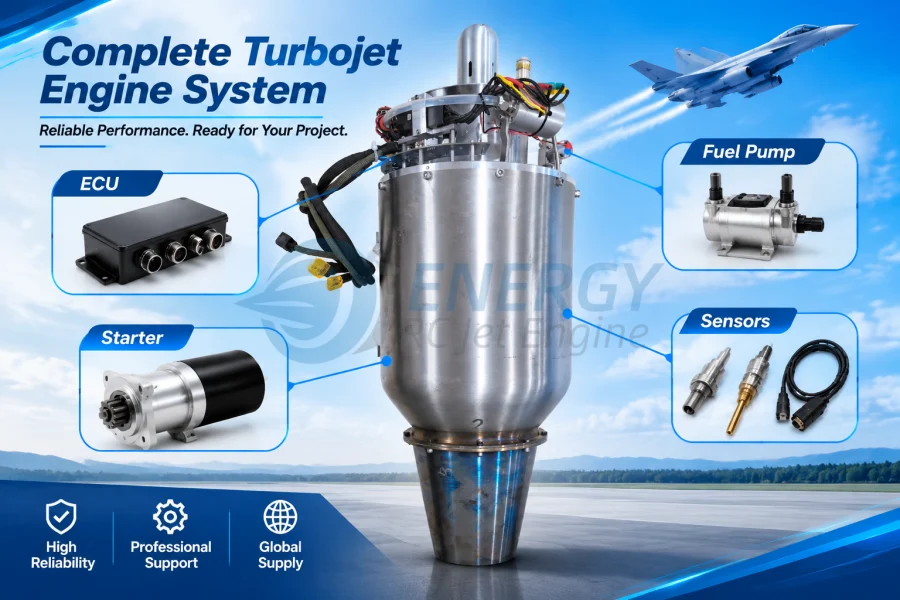
When purchasing a turbojet engine, buyers often focus on thrust rating, RPM, weight, and price. However, an equally important consideration is understanding what is included in the complete engine system.
A turbojet engine is more than a mechanical propulsion unit. Depending on its design and configuration, it may require an electronic control unit (ECU), starter system, fuel pump, fuel valves, sensors, and other supporting components.
For international buyers, distributors, RC jet enthusiasts, and aerospace engineering teams, understanding these components helps avoid purchasing misunderstandings and makes it easier to compare different manufacturers.
In this guide, Energy RCJetEngine explains the major components of a miniature turbojet engine system, their functions, and what buyers should confirm before placing an order.
1. What Is a Complete Turbojet Engine System?
A complete turbojet engine system generally consists of the engine itself and the supporting electronic, starting, and fuel delivery components required by its specific design.
Depending on the manufacturer and model, the package may include:
Turbojet engine assembly
Unité de contrôle électronique (ECU)
Starter motor or starting mechanism
Pompe à carburant
Fuel valves and associated components
Temperature and speed sensors
Electrical cables and connectors
Control interface and supporting accessories
Not every turbojet engine uses the same configuration. Some manufacturers integrate several components into the engine assembly, while others supply them as separate modules.
Therefore, buyers should always distinguish between an engine-only quotation and a complete system quotation.
2. Electronic Control Unit (ECU): The Core of Engine Management
The Electronic Control Unit (ECU) is one of the most important components of a modern miniature turbojet engine.
It acts as the electronic management system, coordinating engine operation through connected sensors, control components, and electronic interfaces.
Depending on the engine design, ECU functions may include:
Engine Monitoring: Collecting operating information such as rotational speed and exhaust gas temperature.
Fuel Management: Coordinating fuel delivery through the supported fuel system components.
Starting Management: Managing the electronic starting sequence according to the engine manufacturer’s control logic.
Operating Protection: Monitoring relevant operating parameters and providing warnings or protective responses when configured limits are reached.
Communication: Providing interfaces for compatible controllers, monitoring equipment, or other electronic systems.
When comparing turbojet engine ECUs, buyers should ask about supported functions, communication interfaces, sensor compatibility, and whether the ECU is included in the standard package.
A sophisticated ECU can improve monitoring and system integration, but compatibility with the specific engine model remains essential.
3. Starter System: Understanding Different Starting Configurations
A starter system provides the initial mechanical assistance required to bring a turbojet engine into its starting sequence.
Different engine designs use different starting arrangements.
Electric Starter Systems
Electric starters use an electrical motor to provide starting assistance. They are commonly used in miniature turbine engines because of their compact design and electronic control compatibility.
Integrated Starter Systems
Some engines incorporate the starter mechanism into the engine assembly. This can simplify overall system arrangement and reduce the number of separately mounted components.
External Starting Components
Other configurations use separate starting components connected to the engine system.
When evaluating an engine, buyers should confirm whether the starter is integrated or supplied separately, what supporting electrical components are required, and whether the complete starting system is included in the quotation.
It is also important to distinguish between an integrated starter motor and a complete starting package.
Read More:Turbojet Engine for Sale: How to Choose a Reliable Manufacturer and Supplier
4. Fuel Pump and Fuel Delivery System
The fuel delivery system supplies the fuel required for engine operation. Its configuration directly affects system compatibility and overall installation requirements.
A typical miniature turbojet fuel system may include several components.
Fuel Pump
The fuel pump provides the required fuel delivery according to the engine’s design and control requirements.
Fuel Valves
Fuel valves regulate or control fuel flow within the system. Their arrangement depends on the engine configuration.
Fuel Lines and Connectors
These components connect the fuel supply system with the engine and associated equipment.
Fuel Filters
Appropriate filtration helps protect fuel system components from unwanted particles and contamination.
When purchasing a turbojet engine, buyers should confirm whether the fuel pump is integrated into the engine, supplied as a separate accessory, or excluded from the standard package.
Fuel compatibility should also be verified for each specific model. Some engines support Jet A-1 and kerosene, while other models may have additional approved fuel options.
Do not assume that all turbojet engines share identical fuel system requirements.
5. Sensors and Temperature Monitoring
Sensors provide important information about the engine’s operating condition.
Common monitoring parameters include:
Engine rotational speed (RPM)
Exhaust Gas Temperature (EGT)
Relevant system temperatures
Electrical and control system status
RPM information helps the electronic control system monitor rotational speed, while temperature monitoring provides important information about thermal operating conditions.
The exact sensor arrangement varies between engine models.
For buyers, important questions include:
Which sensors are included?
Are temperature sensors integrated or separately installed?
What operating parameters can the ECU display?
Are monitoring interfaces compatible with the intended control system?
Understanding these details helps engineers evaluate the complete electronic configuration rather than comparing engines using thrust ratings alone.
6. Integrated vs. Separate Engine Components: What Is the Difference?
One important difference between turbojet engine products is how supporting components are arranged.
| CONFIGURATION | MAIN CHARACTERISTICS |
|---|---|
| Integrated ECU | Electronic control components are incorporated into the engine system |
| Separate ECU | Control unit is supplied as an independent component |
| Integrated Starter | Starting mechanism is incorporated into the engine assembly |
| Separate Starter | Starting components are provided independently |
| Integrated Fuel Pump | Fuel pump is incorporated into the engine configuration |
| External Fuel Pump | Fuel pump is installed separately |
An integrated configuration may simplify packaging and reduce external component arrangements. However, it does not automatically mean that the engine is easier to install or maintain.
The correct choice depends on the engine architecture, installation environment, service requirements, and project specifications.
Buyers should compare the complete configuration, not just the engine’s external appearance or advertised thrust.
7. What Should You Confirm Before Purchasing a Turbojet Engine?
Before requesting a quotation, it is important to clarify exactly what the supplier will deliver.
Use the following checklist when communicating with a turbojet engine manufacturer:
Engine Model and Thrust: Confirm the exact model and rated thrust.
ECU Configuration: Check whether the ECU is integrated or supplied separately.
Système de démarrage : Confirm the starting mechanism and included accessories.
Fuel Pump: Verify whether the fuel pump is included.
Sensors: Ask which monitoring components are supplied.
Electrical Accessories: Confirm cables, connectors, and compatible interfaces.
Technical Documentation: Request the applicable product specifications and system information.
Spare Parts: Clarify the availability of replacement components and maintenance support.
It is also advisable to request a detailed packing list before confirming the order.
This makes it easier to compare quotations from different manufacturers and reduces the risk of unexpected additional costs.
8. Turbojet Engine System Solutions from Energy RCJetEngine
Energy RCJetEngine offers a range of turbine jet engines covering thrust classes from 1 kgf to 260 kgf.
The product portfolio includes miniature turbojet engines, RC turbine jet engines, and higher-thrust propulsion systems for different engineering and aviation-related requirements.
Depending on the model, available configurations may include:
Electronic control units (ECUs)
Integrated or separate starter systems
Fuel pumps and fuel delivery components
Engine monitoring and sensor systems
Model-specific accessories and supporting components
For example, the EN-P85 features an integrated ECU, oil pump, and oil valve configuration. The S100 incorporates a starter motor and power generation functionality, together with an integrated ECU and fuel pump.
These examples demonstrate why buyers should review the configuration of each individual model rather than assume that every engine has identical components.
Our team can provide model-specific information to help international customers compare engine configurations, evaluate technical requirements, and request suitable quotations.
Foire aux questions
1. Does a turbojet engine come with an ECU?
This depends on the manufacturer and engine model. Some engines include an integrated ECU, while others supply the control unit separately. Always confirm the package contents before purchasing.
2. Is the starter motor included with a turbojet engine?
Some models feature integrated starter systems, while others require separate starting components. Buyers should confirm the exact starting configuration.
3. Does every turbojet engine have an integrated fuel pump?
No. Fuel pump arrangements vary by engine design. Some models integrate the pump, while others use an external fuel delivery configuration.
4. What is the difference between an engine-only package and a complete engine system?
An engine-only package may include only the main engine assembly. A complete system package may also include the ECU, starter, fuel pump, sensors, and other supporting components, depending on the manufacturer’s configuration.
5. How can I compare turbojet engine quotations accurately?
Compare the exact engine model, rated thrust, included accessories, ECU configuration, starter system, fuel pump, warranty terms, and technical support. Make sure each quotation covers an equivalent supply configuration.
Conclusion
Understanding the components of a complete turbojet engine system is essential when comparing manufacturers and preparing for procurement.
The ECU, starter system, fuel pump, sensors, and supporting accessories all contribute to the overall engine configuration. Their arrangement and availability vary between models, making it important to review the complete technical package before purchasing.
If you are looking for a turbojet engine manufacturer offering multiple thrust classes and configurations, Energy RCJetEngine can help you identify suitable models and clarify the included components.
Contacter Energy RCJetEngine
Contact our team for engine specifications, configuration details, pricing, and international supply inquiries.