
















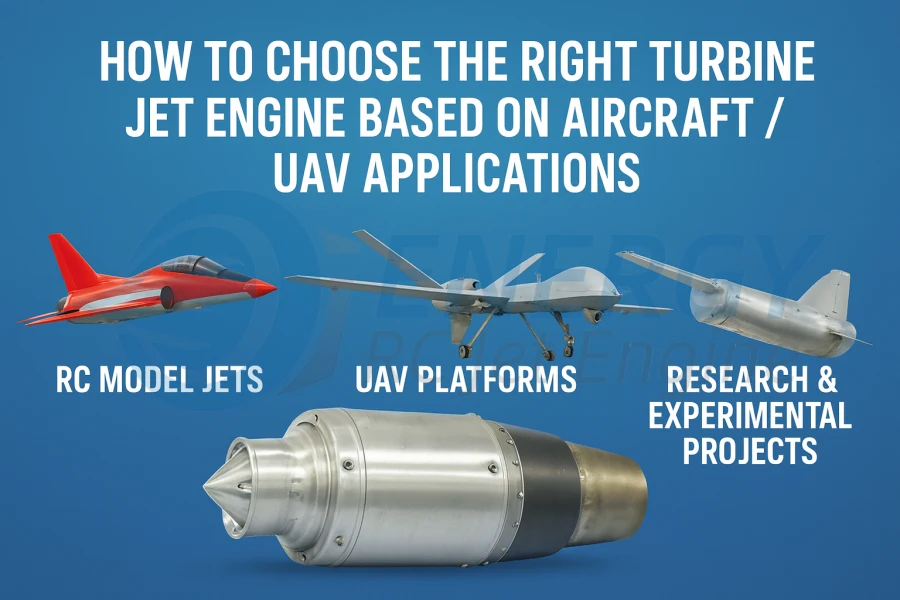
Selecting the right turbine jet engine is one of the most critical decisions for any aircraft project—whether it is an RC model jet, a professional UAV, or a research experiment conducted by a university or aerospace laboratory. The engine defines your aircraft’s overall capability: thrust, efficiency, climb performance, reliability, flight endurance, and operational safety.
Because different aircraft types have completely different missions, operating environments, payload constraints, and integration requirements, a turbine engine that performs perfectly in an RC jet may not be suitable for a UAV or a scientific test platform. This detailed guide is designed to help global buyers understand how to select the ideal turbine engine based on aircraft category, performance goals, and technical constraints.
I. Key Factors Influencing Turbine Engine Selection
Before choosing any micro turbine engine, it is essential to understand the engineering principles and parameters that influence performance.
1. Thrust-to-Weight Ratio (TWR)
Thrust determines:
takeoff capability
climb rate
safe maneuvering
acceleration
ability to carry additional payload
Different applications have very different TWR requirements:
RC jets → High TWR is essential (1.2–2.0+)
UAVs → Balanced and efficient (0.6–1.2)
Research projects → Depends on test objective; may require constant-load operation rather than maximum thrust
Selecting inadequate thrust leads to poor takeoff performance, overheating, or unstable flight.
2. Fuel Type, Consumption & Endurance
Most micro turbines use:
Jet A-1
Kerosene / Paraffin-based fuels
Important considerations:
RC jets: high fuel burn is acceptable due to short flight durations
UAVs: fuel efficiency directly affects mission success
Research: consistent consumption ensures repeatable data
UAV missions may require special fuel tanks, isolation mounts, and fuel pumps to ensure uninterrupted flow during long-duration flights.
Learn More:Performance Tuning & Maintenance Guide for RC Turbine Jet Engines (40–150kgf Range)
3. ECU Functionality & Control Interface
Modern turbines depend heavily on the ECU (Electronic Control Unit), which manages:
Automatic startup
Acceleration limits
Temperature protection
Fuel pump control
RPM management
Telemetry output (RPM, EGT, Fuel Rate)
Safety shutdown logic
Application-dependent needs:
RC jets → Simple, fast-starting ECU
UAVs → Advanced telemetry, autopilot integration, low-vibration throttle control
Research → High-resolution data logging + external DAQ system compatibility
4. Duty Cycle, Thermal Management & Material Durability
Different users stress an engine differently:
| Category | Operating Pattern | Engine Priority |
|---|---|---|
| RC Jets | Short flights, rapid throttle | Heat resistance + fast response |
| UAVs | Long, steady flights | Durability + low fuel burn |
| Research | Start/stop cycles, constant RPM | Stability + precision data |
If the wrong engine class is used, it may lead to:
turbine blade fatigue
premature bearing wear
unstable exhaust temperature
ECU thermal shutdown
5. Airframe Integration
The turbine must be compatible with:
fuselage size / diameter
center of gravity
mounting method
air intake path
exhaust direction
avionics
wiring harness
fuel pump/pipes layout
Improper integration can cause overheating, vibration, or structural failures.
II. Engine Selection for RC Model Jets
RC jets focus on speed, maneuverability, and exciting flight performance. Pilots want powerful engines with sharp throttle response and lightweight construction.
1. Characteristics of RC Model Jet Operations
High-speed level flight
Vertical climbs and aerobatics
Quick throttle changes
Short flight durations (5–15 min)
Performance prioritized over efficiency
Most airframes use carbon or composite fuselages, making lightweight engines essential.
2. Ideal Turbine Features for RC Jets
High thrust-to-weight ratio
Fast, responsive acceleration
Compact design for tight fuselage spaces
Rapid and reliable startup sequences
Low vibration
Simple ECU interface for hobbyists
Many pilots also prefer engines with:
minimal maintenance
smooth idle-to-full throttle transitions
durability under high temperatures
3. Recommended Thrust Range for RC Jets
Different jet styles require different engine sizes:
| Type of RC Jet | Typical Thrust Range |
|---|---|
| Sport jets | 40–60 kgf |
| Large scale jets | 80–150 kgf |
| Twin-engine models | 2 × 40–60 kgf or higher |
Engines must be matched not only to weight but also to airframe aerodynamics and flying style.
4. Typical RC Jet Applications
Aerobatic flying
Sport flying
High-speed racing
Airshow demonstrations
Competition flights
Engines for RC jets focus on excitement, maneuverability, and raw power.
III. Engine Selection for UAV Platforms
UAVs have entirely different mission requirements compared to RC jets. Their priority is efficiency, endurance, stability, and reliability, often under mission-critical conditions.
1. UAV Operational Demands
UAV engines must support:
steady RPM operation for long periods
predictable throttle response for autopilot control
minimal vibration affecting onboard cameras or sensors
low fuel consumption
strong performance at high altitudes or hot climates
stringent safety protocols
In UAV operations—especially in defense, mapping, or delivery missions—engine failure is unacceptable.
2. Ideal Turbine Features for UAVs
High endurance bearings for long mission hours
Optimized fuel efficiency
Stable power curve for autopilot-controlled throttle
Low thermal signature when required
Complete telemetry output (RPM, EGT, fuel flow)
Compatibility with Pixhawk, Auterion, CUAV, or proprietary autopilots
Fail-safe shutdown and restart ability
Low vibration engine design
A UAV-optimized turbine is engineered differently from a standard RC turbine.
3. Recommended Thrust Range for UAVs
| UAV Category | Typical Thrust Range |
|---|---|
| Small Tactical UAV | 30–60 kgf |
| Medium UAV | 70–120 kgf |
| Heavy UAV / Cargo UAV | 120–150+ kgf |
| VTOL Hybrid UAV | High-torque, stable thrust |
UAV thrust selection must consider:
takeoff weight
payload
climb rate
redundancy
max endurance profile
4. UAV Application Scenarios
ISR (Intelligence, Surveillance, Reconnaissance)
Terrain mapping & LiDAR missions
Border patrol
Pipeline & powerline inspection
Fixed-wing cargo UAV
Defense R&D aircraft
Long-endurance scientific missions
For professional UAVs, endurance and reliability always outrank pure power.
Read More:Understanding the Key Components of a Small Turbine Jet Engine
IV. Engine Selection for Research & Experimental Platforms
Research institutions and aerospace laboratories use turbine engines for testing, data collection, and advanced development.
1. Typical Requirements for Research Engines
Highly repeatable performance for scientific comparison
Stable temperature and RPM under controlled test conditions
Detailed data availability (RPM, EGT, fuel pressure, thrust)
Programmable or externally controlled ECU
Modular design for easy instrument mounting
Research engines may operate in:
wind tunnels
static test stands
endurance tests
autonomous control experiments
2. Ideal Engine Features for Research Use
High-resolution sensors
Extended data logging and export tools
Compatibility with DAQ systems
Precision RPM control
Customizable fuel system
High thermal stability
Repeatable startup/operation cycles
Robust internal materials to handle frequent start-stop sequences
3. Recommended Thrust for Research Platforms
| Research Category | Thrust Range |
|---|---|
| Educational experiments | 20–60 kgf |
| Propulsion performance tests | 60–150 kgf |
| Novel propulsion R&D | Custom thrust |
| Hybrid-electric systems | 40–120 kgf depending on project |
Researchers may prioritize stability and sensor precision over maximum power.
4. Example Use Cases
University aerospace programs
Turbojet experimental projects
CFD validation
Wind tunnel propulsion modeling
Artificial intelligence flight control experiments
Hybrid propulsion technology development
Thermal imaging research
Research engines must be accurate, stable, and capable of delivering consistent data.
V. Comparison Table — RC Jets vs. UAVs vs. Research Platforms
| Category | RC Model Jets | UAV Platforms | Research / Experimental |
|---|---|---|---|
| Primary Mission | Aerobatics & speed | Endurance, reliability | Data collection |
| Typical Flight Time | 5–15 min | 2–8 hours | Variable |
| Thrust-to-Weight Preference | Very high | Balanced | Test-dependent |
| Fuel Efficiency Importance | Low | Very high | Medium |
| Throttle Behavior | Fast & aggressive | Smooth & stable | Precise & adjustable |
| ECU Requirements | Simple & fast | Autopilot integration | High-resolution logging |
| Engine Material Focus | Heat resistance | Fatigue resistance | Stability |
| User Type | Hobbyist | Industrial / Government | Universities / Labs |
VI. Step-by-Step Engine Selection Checklist
✔ 1. Identify your aircraft category
RC jet, UAV, or research platform?
✔ 2. Calculate takeoff weight & required TWR
RC jets: 1.2–2.0× weight
UAV: 0.6–1.2× weight
Research: depends on test case
✔ 3. Define mission duration & fuel capacity
Especially important for UAV missions.
✔ 4. Check ECU compatibility
Does it support autopilot? High-rate logging? Safety functions?
✔ 5. Evaluate integration constraints
fuselage size
airflow
CG balance
exhaust clearance
✔ 6. Consider environmental factors
High altitude, cold weather, sandy environments, humidity.
✔ 7. Determine maintenance requirements
Long missions require engines with extended service life.
✔ 8. Contact manufacturer for technical evaluation
Best practice for UAV or research projects.
VII. Example Engine Recommendations by Application
(Adjust model names based on your real product line)
For RC Model Jets
EN-P40 — Lightweight sport jet engine
EN-P60 — High-response aerobatic engine
EN-P80 — Large jet performance engine
For UAV Platforms
EN-P80 — Efficient small UAV engine
EN-P100 — Medium-range endurance engine
EN-P150 — Heavy or cargo UAV propulsion
For Research & Experimental Projects
EN-P60 — Lab-scale testing
EN-P80 — General research & performance tests
EN-P150+ — High-thrust aerodynamic experiments
VIII. Conclusion
Choosing the right turbine jet engine requires a deep understanding of your aircraft’s mission, structural design, and operational constraints. RC jets demand high performance and rapid throttle response; UAVs require efficiency, durability, and autopilot compatibility; research platforms prioritize stability and high-quality data.
By evaluating thrust needs, ECU capability, fuel efficiency, and integration requirements, you can confidently select the perfect engine for your specific application.
For personalized technical guidance, OEM development, or custom turbine engine solutions, our engineering team provides full support for global clients across RC aviation, UAV manufacturers, and aerospace research institutions.