
















Introduction
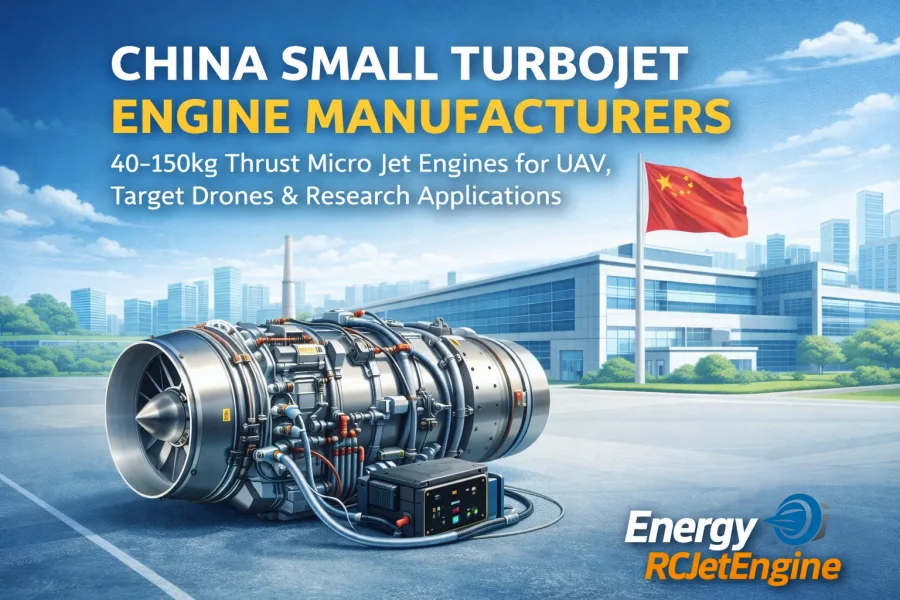
In recent years, small turbojet engines in the 40–150 kg thrust class have become a critical propulsion solution for unmanned aerial vehicles (UAVs), aerial target drones, experimental platforms, and advanced research programs. These compact micro jet engines combine high thrust-to-weight ratios with reliable continuous operation, making them ideal for applications requiring stable high-speed propulsion and precise control.
China has emerged as one of the world’s most important manufacturing bases for small and medium thrust turbojet engines. With mature precision machining, advanced balancing technology, and scalable factory production capacity, Chinese manufacturers now supply micro turbojet engines to customers across aerospace research, training systems, UAV developers, and system integrators worldwide.
As a specialized supplier and manufacturer partner, Energia RCJetEngine focuses on providing factory-direct small turbojet engines in the 40–150 kg thrust range for international UAV, research, and institutional customers.
The Growing Demand for 40–150 kg Thrust Turbojet Engines
The 40–150 kg thrust segment occupies a unique position in modern unmanned propulsion systems. Engines in this class are powerful enough to support:
High-speed fixed-wing UAV platforms
Aerial target and training drones
Experimental aircraft and technology demonstrators
Propulsion test benches and academic research projects
Compared with piston engines or electric propulsion, small turbojets offer:
Higher cruise and dash speed capability
Stable thrust output at altitude
Compact mechanical structure
Continuous high-RPM operation
These characteristics make micro turbojet engines especially suitable for platforms used in flight testing, training missions, aerodynamic validation, and system integration verification.
China as a Global Manufacturing Base for Micro Turbojet Engines
China’s advantage in small turbojet manufacturing is built on three decades of experience in precision rotating machinery, aerospace component production, and turbine balancing technology.
Today, Chinese turbojet factories offer:
CNC-machined compressor and turbine components
High-temperature alloy turbine wheels
Precision dynamic balancing systems
Scalable production lines from prototype to batch delivery
Most factories supporting this segment maintain in-house testing facilities, including thrust stands, endurance rigs, vibration measurement systems, and fuel consumption monitoring.
For international customers, China provides a rare combination of:
Competitive manufacturing cost
Stable quality control
Flexible customization capability
Reliable long-term supply
A Energia RCJetEngine, we cooperate with trusted Chinese factories specializing in small and medium thrust micro turbojet engines, ensuring consistent performance, documentation support, and export-ready configurations.
Typical Technical Characteristics of 40–150 kg Micro Turbojet Engines
Although specifications vary by model and application, turbojet engines in this thrust range generally share several common characteristics:
Maximum Rotational Speed: 85,000 to 125,000 RPM
Idle Speed: 35,000 to 55,000 RPM
Peso a secco: Typically 3.5 kg to 12 kg depending on thrust level
Engine Length: 220 mm to 480 mm
Maximum Diameter: 90 mm to 180 mm
Fuel Type: Kerosene, Jet-A, Jet-A1, or aviation-grade diesel
Lubrication: Pre-mixed oil or separate oil system (model dependent)
Control System: Full Authority Digital Engine Control (FADEC) or industrial-grade ECU
Start Method: Electric starter, air-assisted starter, or hybrid start
Restart Capability: Ground restart and limited in-flight restart (configuration dependent)
Performance Parameters (Typical Ranges)
Maximum Exhaust Gas Temperature (EGT): 650°C to 780°C
Continuous Operating EGT: 580°C to 700°C
Specific Fuel Consumption: 1.1 – 1.5 kg/kgf·h (depending on thrust class and regime)
Fuel Flow at Max Thrust:
40–60 kg class: 0.9 – 1.5 L/min
70–100 kg class: 1.6 – 2.5 L/min
120–150 kg class: 2.6 – 3.8 L/min
Acceleration Time (Idle to Full Thrust): 3 – 6 seconds
Deceleration Time (Full to Idle): 4 – 8 seconds
These performance envelopes allow stable thrust modulation and predictable transient response, essential for flight testing and training missions.
Environmental Operating Envelope
Small turbojet engines in this segment are designed to operate across a wide environmental range:
Operating Altitude: Sea level up to 10,000 – 15,000 meters (platform dependent)
Ambient Temperature Range:
Standard operation: –10°C to +45°C
Extended range with configuration: –20°C to +55°C
Humidity Tolerance: Up to 95% relative humidity (non-condensing)
Crosswind Start Capability: Up to 8–12 m/s depending on inlet design
These environmental margins support deployment in diverse climates and test ranges worldwide.
Key Application Areas
UAV and Unmanned Fixed-Wing Platforms
Small turbojet engines in this thrust range are widely used in high-speed UAV platforms where cruise speed, altitude performance, and thrust stability are critical.
Aerial Target and Training Drones
Target drones used for radar calibration, training missions, and system validation require reliable propulsion with predictable thrust output and repeatable performance.
Research and Experimental Aircraft
Universities, research institutes, and aerospace laboratories utilize micro turbojets for aerodynamic studies, control system validation, and propulsion testing.
Propulsion Test and Integration Programs
System integrators often deploy these engines on test platforms to evaluate sensors, communication systems, and onboard electronics under realistic flight conditions.
Factory Capabilities and Customization Options
One of the major strengths of Chinese turbojet manufacturers lies in flexible customization.
Typical customization options include:
Thrust calibration for specific airframes
ECU control law tuning and throttle mapping
Fuel pump and injector selection
Starter system configuration
Exhaust nozzle geometry optimization
Thermal shielding and insulation options
Mounting flange and vibration isolator design
Interface and Integration Parameters
Electrical Supply: 12V / 24V DC systems
ECU Communication: PWM, CAN bus, RS232 / RS485 (model dependent)
Throttle Input: Analog voltage, PWM, or digital command
Sensor Outputs:
Feedback sul numero di giri
EGT signal
Fuel pump current
System status and fault codes
This standardized interface architecture simplifies integration with autopilot systems, telemetry units, and onboard data recorders.
Factories can support:
Prototype development
Small batch production
Long-term supply programs
Spare parts and overhaul support
A Energia RCJetEngine, we provide full coordination between customer requirements and factory engineering teams, ensuring each engine is optimized for its intended platform.
Reliability, Durability, and Life Parameters
Engine reliability is a critical factor for training and research operations.
Typical durability indicators include:
Mean Time Between Overhaul (MTBO): 25 – 100 operating hours depending on thrust class and duty cycle
Bearing Design Life: 200 – 500 hours equivalent operation
Start-Stop Cycle Rating: 300 – 1,000 cycles
Maximum Continuous Run Time: 30 minutes to 4 hours (model dependent)
Critical life-limiting components include:
Turbine wheel material and cooling design
Main shaft bearing system
Combustion liner thermal fatigue margin
Fuel nozzle erosion resistance
Professional Chinese manufacturers conduct accelerated endurance testing to validate component life and thermal stability before serial production.
Quality Control and Testing Standards
Reliable performance is essential for unmanned propulsion systems. Professional Chinese turbojet factories maintain strict quality procedures, including:
Rotor dynamic balancing at multiple speed stages
High-speed overspeed margin verification
Thermal stress and casing expansion validation
Thrust curve mapping across RPM range
Repeated cold and hot start qualification
Each engine is typically delivered with:
Factory acceptance test report
Thrust and fuel flow curves
ECU configuration file
Vibration baseline record
Operating and maintenance manual
This documentation allows system integrators and research users to integrate engines efficiently and safely into their platforms.
Global Supply and Export Support
Small turbojet engines manufactured in China are now exported to:
North America
Europe
Middle East
South America
Southeast Asia
Africa
International customers benefit from:
Stable lead times
Export documentation support
Technical communication in English
After-sales service coordination
Spare parts and overhaul planning
Energia RCJetEngine works with global customers, system integrators, research institutions, and industrial partners to deliver reliable propulsion solutions for long-term programs and repeated procurement.
Choosing the Right Manufacturer and Supplier
When selecting a turbojet engine supplier in this thrust class, buyers should evaluate:
Factory production history and reference programs
In-house testing and balancing capability
Parameter transparency and documentation quality
Customization depth and engineering support
Long-term spare parts availability
Export compliance and logistics experience
Working directly with specialized suppliers who cooperate with qualified factories significantly reduces integration risk and ensures long-term operational stability.
Conclusione
The 40–150 kg thrust micro turbojet segment continues to play a vital role in modern UAV propulsion, training systems, and aerospace research platforms. China has become one of the world’s most important manufacturing centers for this class of engines, offering reliable technology, scalable production, and flexible customization.
As a professional supplier and manufacturer partner, Energia RCJetEngine is committed to delivering factory-direct small turbojet engines for UAV, target drone, and research applications worldwide.
For customers seeking stable performance, technical transparency, and long-term supply capability, China remains a strategic and reliable source for advanced micro turbojet propulsion systems.